
Categories
local InsightsPublished November 27, 2026
Buying a horse property in Washington: what I check first

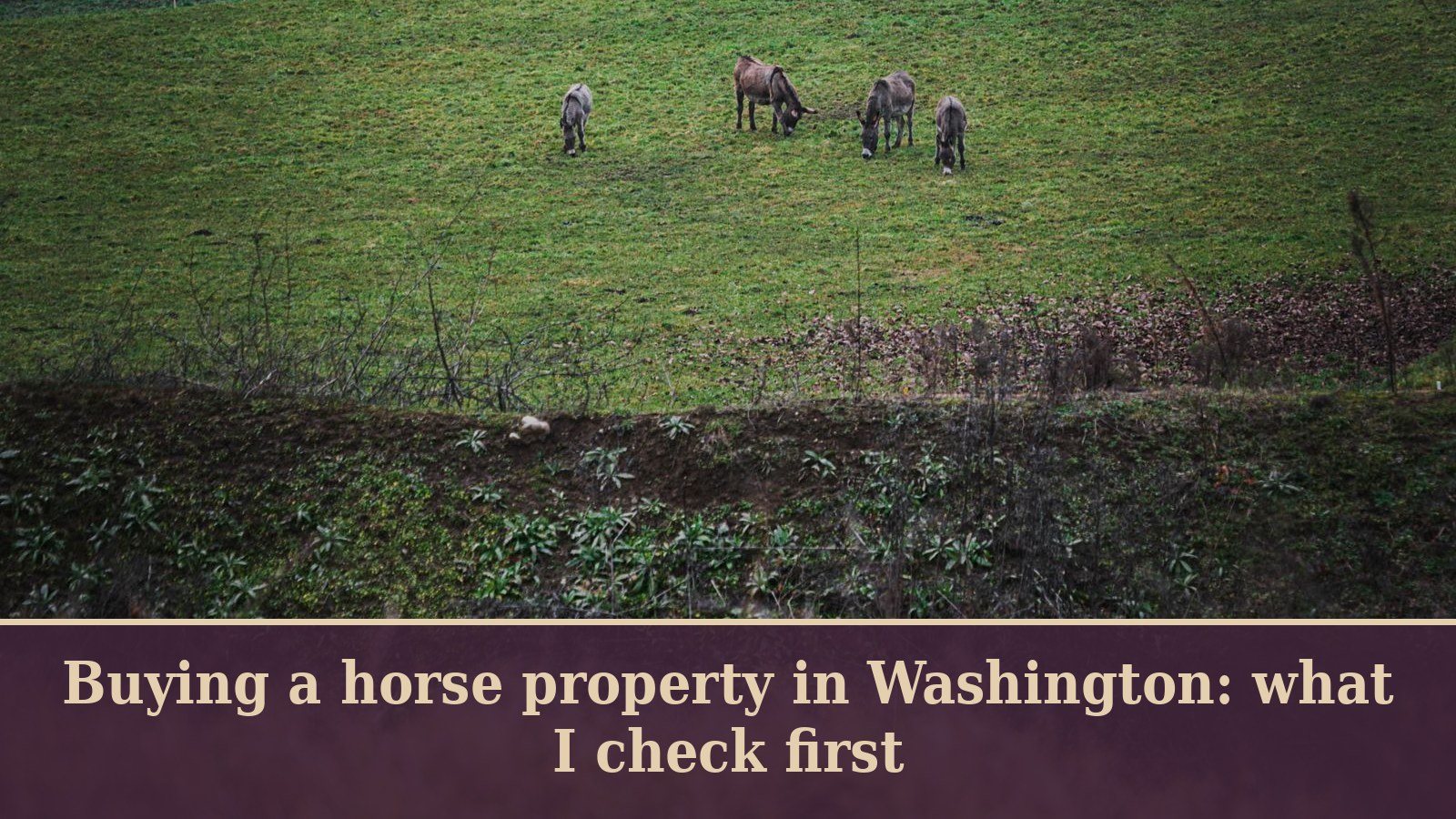
I ride every week, and I work with buyers who want to bring their horses home. Horse properties are the most involved purchases I handle, because you are buying a home, a small farm and a barn's worth of infrastructure at once. This is the checklist I walk through with buyers before we write an offer, in the order I check things.
The market context first. Equestrian homes in the Puget Sound region sold at a median of $857,500 in the first quarter of 2026, up about 3 percent year over year, with 88 sales across King, Pierce, Kitsap and Thurston counties, the same count as the year before. Inventory is higher than for non-equestrian homes, and listings take about three months to go under contract, which means buyers have room to be careful. (Washington Horse Properties, May 2026.)
Does the zoning allow your plan?
Zoning decides how many horses you can keep, whether you can board for income, and what you can build. Check the county code for the specific parcel, not the neighborhood. King, Pierce and Snohomish counties all differ, and two properties a mile apart can have different rules. If you plan to add a barn or an arena, confirm what permits that takes before you buy, not after.
Where does the water come from?
Most horse properties run on private wells, and horses drink a lot, roughly 5 to 10 gallons a day each, more in work. Ask for the well log, the flow rate and a recent water quality test, and ask about water rights if you plan to irrigate pasture. A property that cannot water your horses and your grass is a different property than the listing describes.
What is the septic situation?
Rural Washington runs on septic, and the rules just tightened. Since November 1, 2026, sellers in Snohomish County must have the septic system inspected by a certified professional and share the documentation with the buyer before closing, and every Washington county must have a similar program in place by February 2027. The Snohomish County Health Department publishes the requirements at snohd.org. Ask for the report early, and read it the way you would read a home inspection.
Will the land handle a Washington winter?
Mud is the honest issue. Our winters are wet, and horses are hard on wet ground. Look at how the property drains, where the sacrifice areas are, what the footing is made of, and whether the barn sits above or below the wet ground. Visit after a week of rain if you can. A property that shows beautifully in August tells you almost nothing about February.
What shape are the barn, arena and fencing in?
Replacing fencing costs real money, and arena footing is a specialty item. Walk the fence line, look for rot and leaning posts, and ask when the arena footing was last replaced and how it drains. An indoor arena changes how you ride all year in this climate, and it is priced into the property, so evaluate it like the structure it is.
Can you get a trailer in and out?
Access sounds trivial until the hay truck cannot turn around. Check the driveway grade, the turnaround, any bridge or culvert between the road and the barn, and what the drive looks like after a month of rain.
Questions horse property buyers ask me
- How many acres do I need per horse? A common rule of thumb is one to two acres per horse for grazing, but in our climate drainage and sacrifice areas matter more than the raw number. I would rather see three well-drained acres than ten wet ones.
- Is now a good time to buy a horse property? Inventory is higher than it has been in years and listings take about three months to sell, which gives buyers time to do every check in this post. That is the friendliest version of this market buyers have had in a while.
- Can I board horses for income to offset the cost? Sometimes, and zoning plus insurance decide it. We verify both before you count that income in the purchase.
Sources
- Washington Horse Properties, Q1 2026 equestrian home market update: washingtonhorseproperties.net
- Snohomish County Health Department, property transfer septic requirements: snohd.org/1872/Property-Transfer
If you are weighing a horse property and want to talk through what I check before an offer, start the conversation at lzahomes.com/connect or call (253) 302-7571.
Lubaba Al-Arab is a real estate agent with Keller Williams Eastside, based in Kirkland, Washington. Licensed since 2015, she works with buyers and sellers across Kent, Covington, Kirkland, Redmond and Snohomish County, in English and Arabic.

Lubaba Al-Arab
Realtor® | LZA Homes | Lubaba Al-Arab | KW Eastside
or another way